
How to Find the Perfect Memory Care Facility for Your Loved On
Finding the perfect memory care facility for your loved one can be a daunting task (!). There are so many things to consider and it's important to make sure that you get it right. With all of the options out there, it can be difficult to narrow down the search and come to a decission. However, with a bit of research and some guidance, you can feel confident in selecting a memory care facility that meets your needs. Firstly, it is essential to look into the qualifications of staff at any potential memory car facility. You want to be sure that they have experience dealing with those who suffer from dementia or Alzheimer's and that they are well-trained in providing quality care. Secondly, when choosing a memory care facility for your loved one, its importatnt to assess what kind of activities and amenities they offer! This will give you an idea about how much stimulation and enrichment they provide on a daily basis – something which is key in maintaining mental health. Make sure to ask questions about whether or not there are outdoor spaces availible as well as any other activities offered by

What is the Difference Between Assisted Living and Memory Care Facilities?
Assisted living and memory care facilities are two different types of residential care homes that offer various levels of support for seniors. Assisted living provides everyday assistance with activities like bathing, dressing, meal preparation, and general housekeeping. Memory care offers specialized services to those dealing with Alzheimer's or other forms of dementia. While both provide a safe environment and socialization opportunities, there are some key differences between the two. First off, (memory care) is specifically designed for individuals with memory impairments! The staff is trained in understanding how to work with individuals who have difficulty processing information or remembering details. Additionally, the facility itself has security measures in place to ensure residents don't wander away on their own. This includes things such as coded entrances and exits as well as alarms on doors that sound when opened improperly. Conversely, assisted living does not have these stringent safety protocols in place. In fact, many assisted living communities do not even require medical evaluations prior to admission! That said, they do still focus heavily on providing assistance with daily tasks such as medication management and grooming needs. Furthermore, these facilities tend to be more social

The Benefits of Memory Care Facilities
Memory care facilities offer a range of benefits for those struggling with memory issues! It is not an easy decision for families to make, but the many advantages (such as providing a safe environment and resources) can be invaluable. Firstly, memory care facilities provide 24/7 supervision and security. This ensures that residents are safe and secure at all times and allows family members to rest assured that their loved ones are receiving proper care. Residents can receive assistance with daily activities, such as bathing, grooming, dressing and eating. This helps them maintain their independence while also getting the help they need. Additionally, these facilities often have specialized programming designed to maximize cognitive functioning in individuals with dementia or Alzheimer's disease. Activities like music therapy or reminiscence therapy can help reduce agitation and improve communication skills. Furthermore, there may be educational programs available which teach residents how to manage their condition through various coping strategies. Moreover, socialization is an important part of life for those living in memory care facilities. Not only do residents get the chance to interact with other people who are going through similar experiences, but staff members
Mild dementia due to Alzheimer's disease
Jankovic j, et al. , eds. Alzheimer disease and other dementias. In: bradley and daroff's neurology in clinical practice. 8th ed. Elsevier; 2022. Https://www. Clinicalkey. Com. Accessed sept. 21, 2022. Alzheimer's disease fact sheet. National institute on aging. Https://www. Nia. Nih. Gov/health/alzheimers-disease-fact-sheet. Accessed oct. 3, 2022. Livingston g, et al. Dementia prevention, intervention, and care: 2020 report of the lancet commission. The lancet. 2020; doi:10. 1016/s0140-6736(20)30367-6. Chen l, et al. Plasma tau proteins for the diagnosis of mild cognitive impairment and alzheimer's disease: a systematic review and meta-analysis. Frontiers in aging neuroscience. 2022; doi:10. 3389/fnagi. 2022. 942629. Dementia. World health organization. Severe dementia due to Alzheimer's disease The definition of dementia has been updated in the dsm-5 criteria. It is actually no longer termed dementia but is now called major neurocognitive disorder (mnd). However, due to the common use of the term dementia in society and medical literature, it will be referred to as both dementia and major neurocognitive disorder in this article. It is worth noting the limitations of using the term dementia, including its common association exclusively with older patients, and that it is often used synonymously with alzheimer disease. Major neurocognitive disorder can affect younger individuals
Alzheimer's stages: How the disease progresses
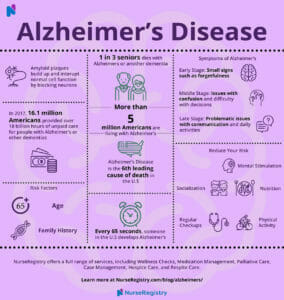
The course of alzheimer's is generally described in three stages, with a progressive pattern of cognitive and functional impairment. The three stages are described as early or mild, middle or moderate, and late or severe. The disease is known to target the hippocampus which is associated with memory , and this is responsible for the first symptoms of memory impairment. As the disease progresses so does the degree of memory impairment. The symptoms of alzheimer's disease worsen over time, although the rate at which the disease progresses varies. On average, a person with alzheimer's lives four to eight years after diagnosis, but can live as long as 20 years, depending on other factors. Changes in the brain related to alzheimer's begin years before any signs of the disease. This time period, which can last for years, is referred to as preclinical alzheimer's disease. The stages below provide an overall idea of how abilities change once symptoms appear and should only be used as a general guide. (dementia is a general term to describe the symptoms of mental decline that accompany alzheimer’s and other brain diseases. As dementia progresses, many people will need around-the-clock help with personal care, including

What is memory care?
Dementia is a progressive condition. A doctor will be able to diagnose a dementia patient’s progression and recommend around-the-clock memory care . But in general, dementia patients should likely move into dedicated memory care if the condition has advanced to a point where it can’t be managed at home. Signs that someone needs 24-hour memory care include: agitation or aggression that puts others or themselves at risk increased slips or falls, or unexplained bruises and cuts tendency to wander or get lost inability to manage medication scheduling or dosage unexplained weight loss or nutrition problems caregiver burnout caring for a loved one with dementia can be challenging and taxing — but it can also be rewarding and bring you closer to that loved one, particularly in early stages of cognitive decline. Getting old affects our physical and mental abilities. Creaky joints, arthritis and forgetfulness are all common signs that we’re not as young as we used to be. However, if your loved one is showing signs of memory problems then there may be something beyond old age going on. This is where memory care comes in - providing housing and 24-hour care for those living with alzheimer’s and other forms of dementia. In this article,

What is a Memory Care Facility?
memory care facilities are regulated at the state level, therefore, the staffing and certification requirements vary throughout the country. In general, most states require that any facility offering memory care services holds a state long-term care license. In order to fulfill licensing requirements, memory care communities must pass health and safety inspections and have a designated administrator who spends at least 40 hours on-site each week and is trained in long-term care. Many states have adult protection laws that mandate extensive background checks for anyone who provides direct care to vulnerable adults, including caregivers who work in memory care facilities. A memory care facility provides specialized residential care for people living with alzheimer’s disease and other forms of dementia. To be eligible for memory care, older adults must have a diagnosis of dementia and a need for around-the-clock supervision. Most memory care facilities offer dementia-specific care and activities, including gardening, exercise, and cognitive games and therapies. The cost of memory care can reach six figures per year. You can pay with private savings and assets or long-term care insurance. In some cases, medicaid will help to cover the cost of memory care for eligible older adults. The